
Why do 61% of apparel returns stem from sizing issues? Amazon size charts provide detailed measurements that help customers select the correct fit, reducing returns by up to 32% while increasing conversions. This guide covers requirements, upload steps, and optimization strategies for maximum sales impact.
Quick Summary
- Size charts reduce returns by 32% by providing accurate measurements that help customers select the correct fit, with 61% of apparel returns stemming from sizing issues
- Base requirements: All US apparel requires target gender, age range, size class, and size value, with product-specific fields for shirts (neck/sleeve), pants (waist/inseam), and shapewear (cup/band)
- Upload process: 4-step workflow through Seller Central tool → identify ASIN → download/edit template → publish (5-7 day review)
- Optimization strategy: Use 2000×2000px images positioned as 2nd-3rd gallery slot with 4:5 aspect ratio, visual measurement guides, and quarterly accuracy reviews
What Is An Amazon Size Chart And Why Does It Matter?
An Amazon size chart provides product-specific measurement information on detail pages, displaying exact dimensions such as chest, waist, and length in both inches and centimeters. Brand-registered sellers customize these charts to align their product sizing with standard formats, helping customers select the correct fit and significantly reducing return rates.
Size charts deliver critical benefits for both sellers and customers:
- Reduces returns and associated costs: Sizing inconsistencies rank among the top reasons for product returns in apparel categories. Accurate charts with standardized measurements help customers make informed decisions, minimizing costly returns for sellers.
- Improves customer confidence and conversions: Clear measurement information removes purchase uncertainty and encourages buyers to complete transactions. When customers trust that products will fit properly, conversion rates increase significantly.
- Enables sizing standardization: International manufacturers often use different sizing systems that confuse customers. Amazon’s charts translate varied measurements into consistent, localized sizes that align with regional shopping expectations.
- Enhances search visibility: Products with complete and accurate sizing data receive preferential treatment in Amazon’s search algorithm, leading to higher visibility in search results and category listings.
- Supports brand-specific guidance: Sellers can submit custom size charts tailored to their unique product designs. This brand-specific approach addresses fitting issues more effectively than generic sizing, particularly for specialty items.
Amazon Size Chart Requirements Explained
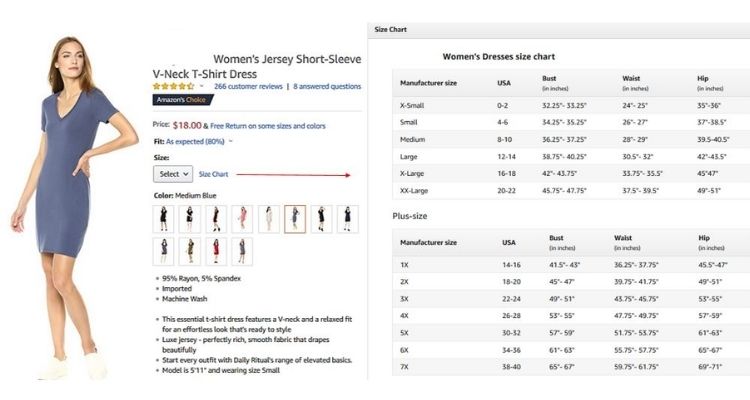
Amazon requires specific size attributes for all US apparel listings to maintain consistency and help customers find the right fit.
Key Apparel Size Attributes Amazon Requires
Amazon requires all U.S. apparel listings to include standardized size attributes to help customers find the right fit and maintain product eligibility.
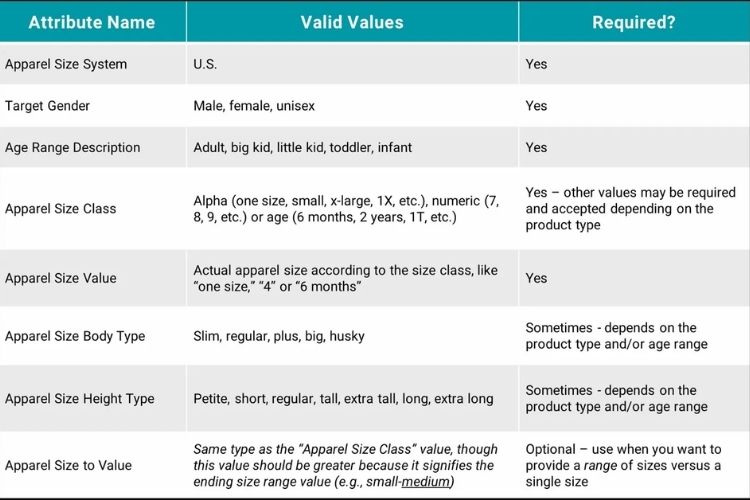
Required attributes for all apparel products:
- Target gender: Male, female, or unisex
- Age range description: Target audience (e.g., “little kid” for ages 6-8, “big kid” for ages 10-12)
- Apparel size class: Sizing format used, such as numerical (size 4) or alpha (small)
- Apparel size value: The actual size of your product
Additional attributes for specific product types:
- Apparel size body type: Slim, regular, plus, big, husky (default: regular)
- Apparel size height: Petite, short, regular, tall, extra tall, long, extra long (default: regular)
Mandatory Attributes By Product Type
Each product category has specific attribute requirements based on its sizing needs.
General Apparel
General apparel products including dresses, coats, sweaters, tunics, pajamas, socks, and underpants require only the base apparel size attributes without additional specialized measurements. Unlike shirts that need neck and sleeve specifications or pants requiring waist and inseam values, these products use simpler sizing combinations.
Required base attributes:
- Target Gender (Male, Female, Unisex)
- Age Range Description (Adult, Kid, Toddler, Infant)
- Apparel Size Class (Numeric, Alpha, or Age)
- Apparel Size Value (the actual size)
Optional attributes based on product type:
- Apparel Size Body Type (Regular, Plus) – conditionally required
- Apparel Size Height Type (Petite, Short, Regular, Tall, Extra Tall) – conditionally required
- Apparel Size To Value (for creating size ranges)
Display format examples:
| Product Type | Attributes | Customer Display |
|---|---|---|
| Dress | Female, Adult, Numeric (40), Regular, Petite | 40 Petite |
| Coat | Female, Adult, Alpha (L), Regular, Regular | L |
| Pajamas | Toddler, Age (2-3 Years), Regular, Regular | 2-3 Years |
| Sweater | Male, Adult, Alpha (M), Regular, Regular | M |
Shirts:
Shirt products offer specialized sizing options, including neck and sleeve measurements, in addition to standard formats:
| Size Class | Required Fields | Display Examples |
|---|---|---|
| Alpha/Numeric | Size Value | L, L Tall, 40 |
| Neck | Neck Size Value | 15″ Neck, 14.5″ Neck Big |
| Neck Sleeve | Neck Size + Sleeve Length | 42 Neck 87-88 Sleeve, 40-42 Neck 88 Sleeve Tall |
Bottoms (Pants, Shorts, Overalls)
Bottom products support waist and inseam measurements for precise fit specifications:
| Size Class | Required Fields | Display Examples |
|---|---|---|
| Alpha/Numeric | Size Value | M, M Plus Short, 32 |
| Waist | Waist Size Value | 40, 31 Long |
| Waist Inseam | Waist Size + Inseam Size | 37W / 32L, 48W x 24L |
Skirts
| Size Class | Required Fields | Display Examples |
|---|---|---|
| Numeric/Alpha | Size Value | 44, M Regular |
| Waist | Waist Size Value | 30, 30 Regular |
Shapewear (Bras, Corsets, Swimwear)
Skirt products can use standard sizing or waist measurements based on design preferences:
| Size Class | Required Fields | Display Examples |
|---|---|---|
| Numeric/Alpha | Size Value | M, 34 Plus |
| Cup Band | Cup Size + Band Size | 32A, 34D, 90D, 28-32J/JJ |
Amazon Men’s Measure Guide
Use these standard measurement tables as a reference for men’s apparel sizing across jackets, shirts, and trousers:
Jackets
| General Size | Chest | Sleeve Length |
|---|---|---|
| XS | 34 inches (86 cm) | 25 inches (63.5 cm) |
| S | 36 inches (91 cm) | 25.25 inches (64.1 cm) |
| M | 38 inches (97 cm) | 25.5 inches (64.8 cm) |
| L | 40 inches (102 cm) | 25.75 inches (65.4 cm) |
| XL | 42 inches (107 cm) | 26 inches (66.0 cm) |
| 2XL | 44-46 inches (112-117 cm) | 26.25-26.5 inches (66.7-67.3 cm) |
| 3XL | 48-50 inches (122-127 cm) | 26.5-26.75 inches (67.3-67.9 cm) |
| 4XL | 52-54 inches (132-137 cm) | 26.75-27 inches (67.9-68.6 cm) |
| 5XL | 56-58 inches (142-147 cm) | 27.25-27.5 inches (69.2-69.9 cm) |
Shirts
| General Size | Neck | Chest | Sleeve Length |
|---|---|---|---|
| S | 14-14.5 inches (35.5-37 cm) | 34-36 inches (86-91 cm) | 31.5-32 inches (80-81 cm) |
| M | 15-15.5 inches (38-39.5 cm) | 38-40 inches (96-101 cm) | 32.5-33 inches (82.5-84 cm) |
| L | 16-16.5 inches (40.5-42 cm) | 42-44 inches (107-111 cm) | 33.5-34 inches (85-86.5 cm) |
| XL | 17-17.5 inches (43-44.5 cm) | 46-48 inches (117-122 cm) | 34.5-35 inches (87.5-89 cm) |
| XXL | 18-18.5 inches (45.5-47 cm) | 50-52 inches (127-132 cm) | 35.5-36 inches (90-91.5 cm) |
Trousers & Jeans – Waist
| General Size | Waist |
|---|---|
| XS | 28-30 inches (71-76 cm) |
| S | 30-32 inches (76-81 cm) |
| M | 32-34 inches (81-86 cm) |
| L | 34-36 inches (86-91 cm) |
| XL | 36-38 inches (91-96 cm) |
| XXL | 40-44 inches (101-111 cm) |
| 3XL | 46-50 inches (117-127 cm) |
| 4XL | 52-54 inches (132-137 cm) |
| 5XL | 56-60 inches (142-152 cm) |
| 6XL | 62-64 inches (157-162 cm) |
Trousers & Jeans – Inseam
| General Size | Inseam Length |
|---|---|
| Extra Short | 27 inches (69 cm) |
| Short | 29 inches (74 cm) |
| Regular | 31 inches (79 cm) |
| Long | 33 inches (84 cm) |
| Extra Long | 35 inches (89 cm) |
Amazon Women’s Apparel Size Chart
Women’s sizing includes four distinct categories to accommodate different body types and proportions:
Regular Sizing
| General Size | US Clothing Size | Chest/Bust (inches) | Waist (inches) | Hips (8″ from waist) |
|---|---|---|---|---|
| XS | 0-2 | 32-33 | 24-25 | 34.5-35.5 |
| S | 4-6 | 34-35 | 26-27 | 36.5-37.5 |
| M | 8-10 | 36-37 | 28-29 | 38.5-39.5 |
| L | 12-14 | 38.5-40 | 30.5-32 | 41-42.5 |
| XL | 16-18 | 41.5-43 | 33.5-35 | 44-45.5 |
Plus Sizing
| General Size | US Clothing Size | Chest/Bust (inches) | Waist (inches) | Hips (8″ from waist) |
|---|---|---|---|---|
| 0X | 12W | 40 | 33 | 42 |
| 1X | 14W-16W | 42-44 | 35-37 | 44-46 |
| 2X | 18W-20W | 46-48 | 39-41 | 48-50 |
| 3X | 22W-24W | 50-52 | 43-45 | 52-54 |
| 4X | 26W-28W | 54-56 | 47-49 | 56-58 |
| 5X | 30W-32W | 58-60 | 51-53 | 60-62 |
Petite Sizing
| General Size | US Clothing Size | Chest/Bust (inches) | Waist (inches) | Hips (8″ from waist) |
|---|---|---|---|---|
| XS | 2P | 32 | 23.5 | 34 |
| S | 4P-6P | 33-34 | 24.6-25.5 | 35-36 |
| M | 8P-10P | 35-36 | 26.5-27.5 | 37-38 |
| L | 12P-14P | 37.5-39 | 29-30.5 | 39.5-41 |
Juniors Sizing
| General Size | US Clothing Size | Chest/Bust (inches) | Waist (inches) | Hips (8″ from waist) |
|---|---|---|---|---|
| XS | 0-1 | 31-32 | 23-24 | 33-34 |
| S | 3-5 | 33-34 | 25-26 | 35-36 |
| M | 7 | 35 | 27 | 37 |
| L | 9-11 | 36-37.5 | 28-29.5 | 38-39.5 |
| XL | 13 | 39 | 31 | 41 |
Amazon Kids and Baby Size Chart
Children’s sizing varies by age range and includes measurements for babies through big kids:
Baby (0-24 Months)
| US Size | Age | Weight (lbs) | Length (inches) |
|---|---|---|---|
| P | Preemie | Up to 5 | Up to 17 |
| NB | Newborn | 5-8 | Up to 20 |
| 3M | 0-3 Months | 8-12.5 | 20-23.5 |
| 6M | 3-6 Months | 13-16.5 | 24-25.5 |
| 9M | 6-9 Months | 17-20.5 | 26-27.5 |
| 12M | 9-12 Months | 21-23.5 | 28-30.5 |
| 18M | 12-18 Months | 24-26.5 | 31-32.5 |
| 24M | 18-24 Months | 27-30 | 33-34.5 |
Little Girls (2-6x)
| US Numeric | US Alpha Size | Age | Weight (lbs) | Height (inches) |
|---|---|---|---|---|
| 2T | 2T | 2 Years | 24-29 | 33-35 |
| 3T | 3T | 3 Years | 29-33 | 35-38 |
| 4T | 4T | 4 Years | 33-37.5 | 39-41 |
| 4 | S (4) | 3-4 Years | 37.5-42 | 42-44 |
| 5 | M (5) | 4-5 Years | 42-46 | 45-47 |
| 6 | L (6) | 5-6 Years | 46-53 | 48-49 |
| 6x | XL (6x) | 6-7 Years | 53-58 | 50-52 |
Little Boys (2-7)
| US Numeric | US Alpha Size | Age | Weight (lbs) | Height (inches) |
|---|---|---|---|---|
| 2T | 2T | 2 Years | 24-29 | 33-35 |
| 3T | 3T | 3 Years | 29-33 | 35-38 |
| 4T | 4T | 4 Years | 33-37.5 | 39-41 |
| 4 | S (4) | 3-4 Years | 37.5-42 | 42-44 |
| 5 | M (5) | 4-5 Years | 42-46 | 45-47 |
| 6 | L (6) | 5-6 Years | 46-53 | 48-49 |
| 7 | XL (7) | 6-7 Years | 53-58 | 50-52 |
Big Girls (7-16)
| US Numeric | US Alpha Size | Age | Height (inches) | Bust (inches) | Waist (inches) | Hips (inches) |
|---|---|---|---|---|---|---|
| 7 | S (7-8) | 6-7 Years | 51-52 | 26-27 | 22.5 | 28 |
| 8 | S (7-8) | 7-8 Years | 53-54 | 27-28.5 | 23.5 | 29 |
| 10 | M (10-12) | 8-9 Years | 55-56 | 28.5-29.5 | 24.5 | 30 |
| 12 | M (10-12) | 10-11 Years | 57-59 | 30-31 | 25.5 | 31-32 |
| 14 | L (14) | 11-12 Years | 60-62 | 31-32 | 26.5 | 33-34 |
| 16 | XL (16) | 12-13 Years | 63-64 | 33-34 | 27.5 | 35-36 |
Big Boys (8-20)
| US Numeric | US Alpha Size | Age | Height (inches) | Chest (inches) | Waist (inches) | Hips (inches) |
|---|---|---|---|---|---|---|
| 8 | S (8) | 7-8 Years | 50-53 | 27-28 | 23-24 | 28 |
| 10 | M (10-12) | 8-9 Years | 54-57 | 28.5-30 | 24-25 | 29 |
| 12 | M (10-12) | 10-11 Years | 58-60 | 30-31 | 25.5-26.5 | 30 |
| 14 | L (14-16) | 11-12 Years | 61-63 | 31-32 | 26.5-28 | 31-32 |
| 16 | L (14-16) | 12-13 Years | 64-65 | 33-34 | 28-29 | 33-34 |
| 18 | XL (18-20) | 13-14 Years | 65-66 | 34-35 | 29-30 | 34-35 |
| 20 | XL (18-20) | 14+ Years | 66-67 | 35-36 | 30-31 | 35-36 |
How To Upload Size Charts To Your Listing
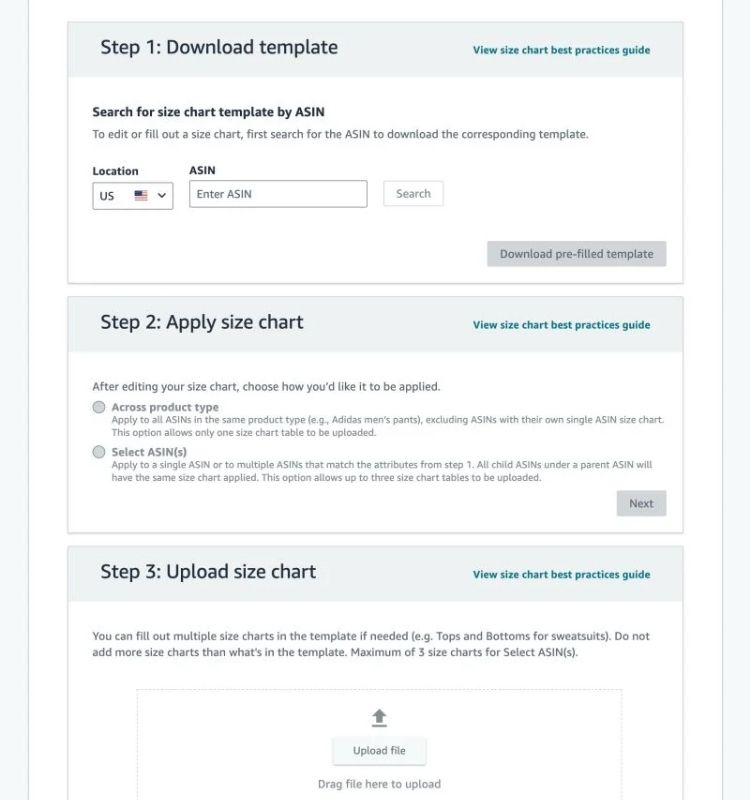
Brand-registered sellers can upload size charts independently by following these four steps:
- Step 1. Access the Tool: Navigate to the Catalog menu in Seller Central and select “Add size charts” from the dropdown options.
- Step 2. Identify Your ASIN: Choose your marketplace location and search for the ASIN you want to add a size chart to. This step identifies the correct department and product type category, such as dresses, pants, or shirts.
- Step 3. Download and Edit Template: Download the Excel template provided by Amazon for your specific product type. Fill in the measurement data for your products according to the template format, then save the completed file.
- Step 4. Upload and Publish: Upload the completed template through the same tool interface. Use the preview function to verify the chart displays correctly, check for any errors or formatting issues, and click “Publish” to make the size chart live on your product listing.
Expert Tips To Optimize Your Size Charts
Implementing these proven strategies maximizes size chart effectiveness and reduces return rates.
Follow Platform Design Standards
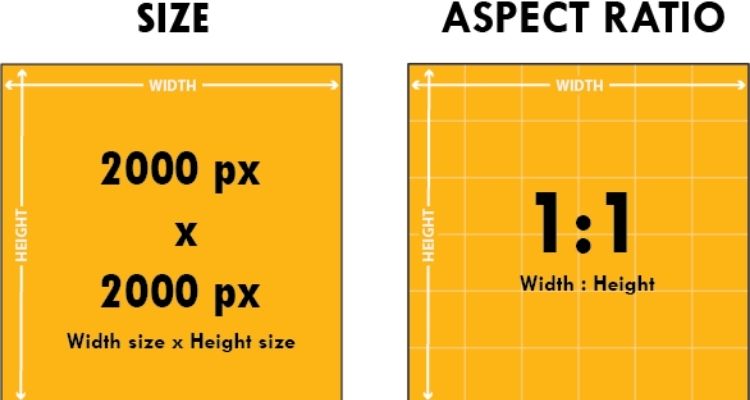
Meeting Amazon’s technical specifications directly impacts your size chart’s visibility across devices. While the platform accepts images between 1000 and 10,000 pixels, optimization requires strategic decisions beyond minimum requirements.
Sellers should adhere to these critical technical standards:
- Use JPEG format with 1600×1600 pixel minimum dimensions to activate zoom functionality, which research shows increases customer confidence and reduces pre-purchase hesitation
- Apply a 4:5 aspect ratio (2000×2500 pixels) for mobile optimization, as this format makes images appear 15-20% larger in smartphone search results compared to standard 1:1 squares
- Ensure size chart tables occupy 85% of the image frame while maintaining text readability, since undersized charts get rejected and oversized text appears pixelated after compression
- Test mobile rendering before publishing, where 60% of Amazon traffic originates, confirming that text remains legible at a minimum 12pt size on smaller screens
Add Descriptive Sizing Instructions
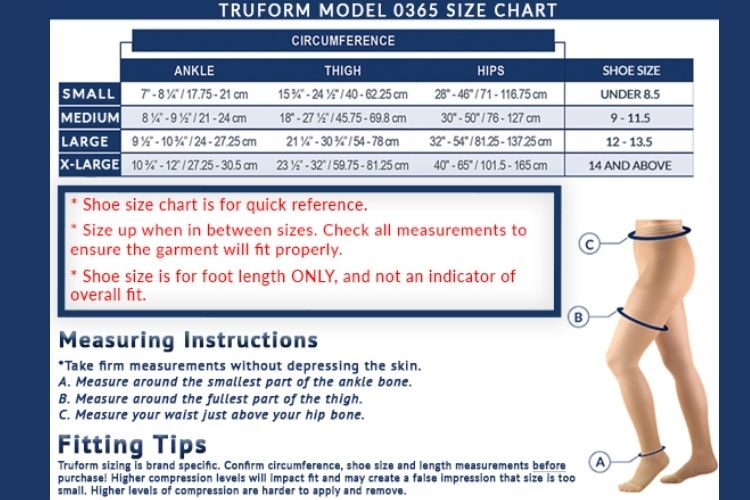
Simply providing measurements without instructions leaves customers confused about how to use them. Studies show 83% of apparel sites fail to include adequate measurement guidance, directly contributing to high return rates.
Effective measurement instructions should include these components:
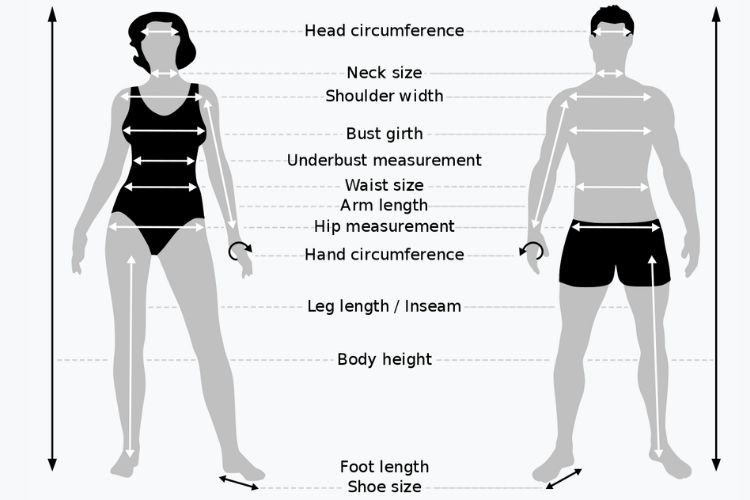
- Provide visual body diagrams showing exactly where to measure chest, waist, hips, and inseam with numbered reference points, as visual guides reduce measurement errors by 40%
- Write specific step-by-step instructions like “Wrap tape under arms around fullest chest part, keeping tape parallel to floor” rather than generic terms that customers interpret differently
- Recommend proper measurement tools, such as flexible fabric tape measures, and suggest alternatives like using string, then measuring against a ruler, for customers without proper tools
- Warn against common mistakes, including measuring over bulky clothing or pulling tape too tight, since these errors account for nearly half of all sizing issues
Maintain Current Size Option Listings
Outdated size information creates purchase barriers and drives returns. Regular maintenance ensures charts match actual inventory and account for manufacturing variations that naturally occur across production runs.
Implement these ongoing maintenance practices:
- Conduct quarterly accuracy reviews by physically measuring 3-5 samples from each production batch, since garment dimensions can vary up to 2.5% between manufacturing runs
- Sync size availability within 48 hours of stock changes, removing discontinued sizes from charts immediately to prevent customer frustration from ordering unavailable options
- Update measurements when changing suppliers or introducing new fits, as knit fabrics typically require different sizing specifications than woven materials due to stretch properties
- Verify consistent grading between sizes, ensuring measurements increase uniformly (2 inches for XS-L, 2.5-4 inches for L+) rather than showing irregular jumps that confuse customers
FAQs About Amazon Size Charts
Only brand-registered sellers enrolled in Amazon Brand Registry can upload custom size charts. Non-registered sellers must contact Selling Partner Support to request a template submission.
Amazon reviews size chart submissions within 5-7 business days. Once approved, charts appear on product listings within 24 hours.
Yes, you can apply a one-size chart template across multiple ASINs within the same product category and brand, as long as the measurements are consistent.
Get Professional Help from Megaficus
Understanding Amazon’s size chart requirements and implementing them correctly reduces returns by up to 32% while increasing customer confidence and conversions. By providing accurate measurements, following platform standards, and maintaining current information, sellers transform size charts from potential confusion points into powerful sales drivers.
Success requires both proper setup and ongoing optimization through strategic image placement, descriptive instructions, and regular accuracy reviews. If you need expert support to optimize your size charts or scale your Amazon business with proven strategies, Megaficus provides hands-on guidance to help sellers maximize performance and achieve sustainable growth.