
Most sellers only check their Amazon Valid Tracking Rate after receiving a warning from Amazon, which is already too late to avoid the impact on account health. The triggers that push VTR below 95% are rarely obvious, and some of them have nothing to do with whether the package actually arrived. Megaficus breaks down how the metric works, what quietly pulls it down, and how to stay ahead of it before Amazon sends the first notice.
Quick Summary
- Amazon Valid Tracking Rate (VTR) measures the percentage of seller-fulfilled shipments sent with valid tracking over a rolling 30-day period, and sellers must keep it at or above 95% at all times.
- How it’s calculated: VTR = (Packages with Valid Tracking / Total Packages Shipped & Confirmed) x 100, with a 95% minimum target, a two-week data lag, and scan requirements that vary by shipment origin and order value.
- Requirements: Sellers must maintain 95% VTR for all MFN shipments using Amazon-approved carriers, with different scan thresholds for domestic, cross-border, and origin-specific shipments.
- Consequences of low VTR: Listing suspension in affected categories, full account suspension, loss of premium shipping eligibility, and reduced search visibility.
- Common causes: Late tracking uploads, mismatched or reused tracking numbers, non-approved carriers, and skipping tracking on low-value orders.
What Is Amazon’s Valid Tracking Rate?
Amazon Valid Tracking Rate (VTR) measures the percentage of shipments a seller sends with valid tracking information over a rolling 30-day period. Amazon introduced this metric to hold sellers accountable for the post-purchase experience, not just the sale itself.
Customers depend on tracking numbers to know when their orders will arrive, and a low VTR signals that shoppers may struggle to monitor their packages without contacting support. By maintaining a healthy VTR, sellers help buyers check carrier status directly from their purchase history, reducing friction on both sides.

How Amazon Calculates Valid Tracking Rate?
Amazon calculates VTR as the percentage of total packages shipped with a valid tracking ID over a rolling 30-day period, with a two-week lag built in for data accuracy. Not every tracking ID qualifies, though, as one only counts as valid when it comes from an Amazon-integrated carrier, is entered before the item is delivered, and generates at least one physical carrier scan that Amazon can show to customers.
To understand how the metric works in practice, here are the key details behind the calculation:
VTR = (Packages with Valid Tracking / Total Packages Shipped & Confirmed) x 100
Note:
- Target: Sellers must maintain a VTR of at least 95%
- Timeframe: Rolling 30-day period with a two-week lag for data accuracy
- Valid Data: Tracking numbers must be entered before delivery, using a carrier from Amazon’s integrated carriers list
For shipments originating from China, Canada, American Samoa, or the US Minor Outlying Islands, packages under $5 need one valid carrier scan, while those valued at $5 or more require two scans, one at the carrier facility and one at delivery or attempted delivery.
The same two-tier structure applies to shipments from India or the UK, with the value threshold set at $15 instead of $5.

Why Valid Tracking Rate Matters for Amazon Sellers?
Maintaining a strong VTR goes beyond policy compliance, as it directly affects how customers experience your store and what selling privileges you get to keep:
- Customer satisfaction: Buyers want to know where their order is at every stage, and valid tracking gives them that visibility without needing to contact support. A smooth post-purchase experience builds trust and encourages repeat purchases.
- Fewer complaints: When customers can monitor their shipment in real time, they are less likely to file disputes or open cases over perceived delays. This keeps your account metrics cleaner and reduces unnecessary back-and-forth with support.
- Program eligibility: A consistently high VTR is a prerequisite for programs like Seller Fulfilled Prime. Letting it slip below the threshold can cost you access to these programs and the visibility advantages that come with them.
- Avoid penalties: If VTR drops below 95%, Amazon may restrict your ability to sell seller-fulfilled items in specific categories or suspend your account entirely. The consequences scale with how far and how long the metric stays below the required level.

Amazon Valid Tracking Rate Requirements
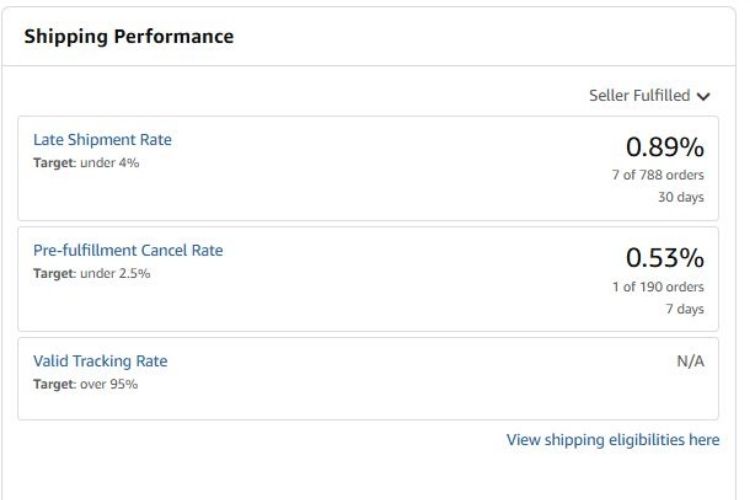
Amazon requires sellers to maintain a VTR of at least 95% across a rolling 30-day period for all seller-fulfilled shipments. Tracking numbers must come from Amazon-approved carriers that integrate with their platform, and sellers in categories like books, media, and video games are exempt from this requirement.
The 95% threshold applies differently depending on the shipment type:
- Domestic shipments: All shipments from and to the same country must include valid tracking.
- Cross-border shipments above £20: Must use a tracked delivery service that provides at least two scans, including a successful or attempted delivery scan.
- Shipments from China to the UK:
- Below £10: at least one carrier scan required
- £10 or above: at least two scans required, including a delivery or attempted delivery scan
If your VTR drops below 95%, Amazon will send a warning first. Continued non-compliance can lead to seller-fulfilled listings being deactivated in the affected category. To reinstate, go to Account Health in Seller Central and submit an appeal next to each affected category.
What Happens If Your Valid Tracking Rate Is Too Low?
Falling below the 95% VTR threshold does not just trigger a warning. Depending on how long and how far the metric drops, the consequences can escalate quickly across multiple areas of your account.
- Listing suspension: Seller-fulfilled listings in the specific category where VTR failed will be deactivated first, directly cutting off your ability to sell those items until reinstated.
- Account suspension: If VTR remains low after warnings, Amazon may escalate to suspending your entire seller account, particularly when the failure reflects a pattern rather than a one-time issue.
- Loss of shipping eligibility: A low VTR can disqualify you from premium shipping options and guaranteed delivery programs, limiting the competitive advantages available to your listings.
- Reduced visibility: Products with poor tracking compliance may receive lower placement in search results, which compounds the revenue impact beyond just the compliance penalty.
- Increased customer service issues: When buyers cannot track their packages, “where is my order” contacts go up, creating additional strain on your support workload and risking further negative feedback on your account.
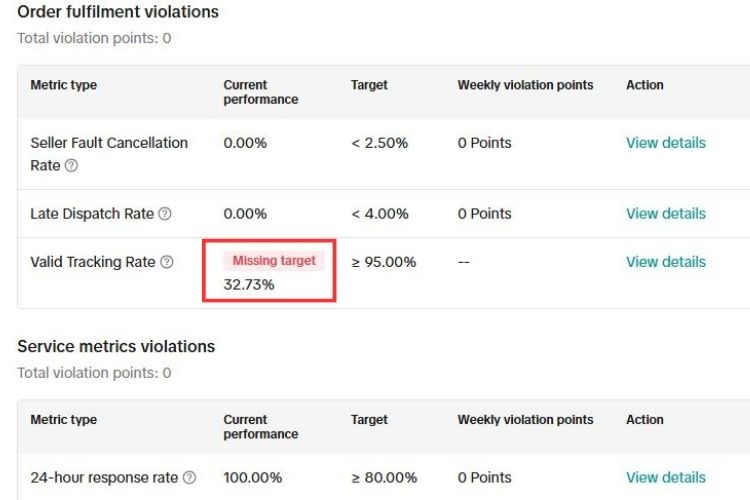
Common Reasons for a Low Valid Tracking Rate
Understanding why VTR drops is the first step to keeping it above the 95% threshold. These are the most common issues sellers run into:
- Late uploads of tracking information: Amazon requires tracking details to be uploaded shortly after an item is shipped. If the upload is delayed, Amazon may count the tracking as invalid even if the package is already in transit and on track for on-time delivery.
- Wrong or mismatched tracking numbers: Typos or pasting the wrong tracking number are more common than most sellers expect. Even a single incorrect digit causes Amazon to flag that order as invalid, which directly pulls down your VTR. A seller shipping 10 packages in one day and accidentally duplicating a tracking number, for instance, will have that order counted against them immediately.
- Using non-approved carriers: Amazon only recognizes tracking data from carriers integrated into their system. If a seller ships through a local or regional courier not on Amazon’s approved list, the tracking information goes unrecognized, regardless of whether the package is delivered successfully.
- Not providing tracking for some orders: Skipping tracking on low-value or small orders is a common mistake. Even if these orders represent a minor share of total shipments, the cumulative effect can be enough to push VTR below 95%.
- Reused tracking numbers: Amazon requires a unique tracking number for every shipment. Reusing a number from a previous order will be flagged as invalid, even if the current package is delivered without any issues.

Best Practices to Improve Your Amazon Valid Tracking Rate
Knowing what causes VTR to drop is only half the equation, and the other half is building a consistent process that prevents those issues from coming up in the first place.
Verify Tracking Numbers Before Shipping
A mismatched tracking number does not just affect one order. If the error goes unnoticed across a batch of shipments, the invalid count stacks up quickly and pulls VTR down before the seller realizes what is happening.
For high-volume operations, integrating barcode scanning tools like ShipStation or ShippingEasy removes human error from the equation by pulling tracking data directly from the carrier and syncing it to Seller Central automatically. For sellers still processing orders manually, copying tracking numbers directly from the carrier confirmation email rather than typing them out reduces mismatch risk significantly.

Use Supported Carriers
Switching to a cheaper regional courier might seem like a cost-saving move, but if that carrier is not on Amazon’s approved list, none of its scans will count toward VTR regardless of how reliably the packages arrive.
Sellers considering a non-standard carrier should run a test shipment first and confirm that Amazon recognizes at least one carrier scan before routing all orders through that provider. Well-integrated options like UPS, FedEx, USPS, DHL, and Amazon Logistics push scan data to the customer’s tracking page in real time, which protects both VTR and the post-purchase experience simultaneously.

Confirm Shipment on Time
Sellers should upload tracking numbers as soon as the package leaves their hands, ideally within 24 hours of shipment. To make this consistent across all orders:
- Set a daily cutoff time for shipment confirmation, for example, every order shipped by 3 PM gets confirmed by 5 PM the same day
- Use automation software that pulls tracking numbers directly from your carrier and syncs them to Seller Central without manual input
- Avoid batching confirmations at the end of the week, as delayed uploads are one of the fastest ways to pull VTR down

Edit Tracking Information When Needed
The edit window closes the moment the carrier marks a package as delivered, which means catching errors early is the only way to fix them in time. Sellers who spot a mistake should go to Manage Orders in Seller Central, locate the order, and update the tracking number immediately rather than waiting to handle it in bulk.
Beyond individual corrections, if the same type of error keeps appearing across multiple orders from the same fulfillment channel, that pattern points to a process gap at the source level, whether that is how labels are being generated, scanned, or entered into the system.

Double-Check Carrier Data
VTR reports in Account Health show exactly which orders were flagged as invalid, and filtering by carrier or fulfillment channel often reveals where the problem is concentrated. Sellers managing multiple warehouses or third-party logistics partners should schedule a monthly carrier performance review to confirm every fulfillment point meets Amazon’s scan requirements.
If one carrier is consistently underperforming, replacing or supplementing it with an Amazon-integrated alternative is usually more effective than repeatedly correcting individual orders after the fact.

FAQs About Amazon Valid Tracking Rate
No. VTR applies only to seller-fulfilled (MFN) orders. FBA orders are exempt because Amazon handles the shipping and tracking directly. Some categories, like books, media, and video games, are also excluded from the 95% requirement.
Amazon updates VTR on a rolling 30-day basis with a two-week lag, meaning recent shipments may not immediately reflect in your current VTR score. Changes made today will typically show up in the metric within two weeks.
Yes. If a carrier is not on Amazon’s approved list, their tracking data will not be recognized, and those shipments will count as invalid regardless of whether the packages are delivered successfully.
Yes, but only if the correction is made before the package is marked as delivered. Once delivery is confirmed, the edit window closes, and the order remains counted as invalid in your VTR calculation.
Get Professional Help from Megaficus
Keeping Amazon’s Valid Tracking Rate above 95% is not as complicated as it sounds, but it does require consistency across every step of the fulfillment process. Small gaps like a delayed upload or an unrecognized carrier add up faster than most sellers expect, and by the time the warning arrives, the metric has already taken a hit.
If you want to tighten up your fulfillment process or recover from a VTR drop, the team at Megaficus is ready to help you build a setup that holds up long-term.